


Continued…..
It fell upon his mother to provide the active care of young Joseph and his sister Sarah Sophia during their formative years at Revesby, due to a mystery illness that left their father crippled and chair-bound until his death in September 1761.The old house whilst heavy, and a graceless mass was at least settled and mature like the deer park and gardens surrounding it. The deer park with its milk cows and small Derbyshire sheep covered 340 acres almost exactly the size of Hyde Park in London. At the age of seven his father engaged the 47-year-old Reverend Henry Shepherd the vicar of nearby Moorby to begin his tutelage. The Rev. Shepherd would often teach at the Abbey or young Banks would walk across the fields to the vicarage. In later years in 1785 on a similar walk an older Joseph Banks recorded and collected the quite rare plant Silene Gallica the ‘Small-leafed Catchfly, the specimen still exists in the Natural history Museum. Patrick O’Brian – Joseph Banks. p.17
Young Joseph enjoyed tremendous freedom and was at his happiest with a fishing rod in hand and a dog at his heels. There was no lack of wildlife for him to observe with the Fen and Wold teeming with partridge, pheasants, woodcock, snipe, wild duck, geese, teal and widgeon as well as hares and rabbits. In Joseph Banks boyhood the fens were known as the ‘aviary of England’ and ‘the great magazine of wildfowl in the kingdom’. Charles Lyte – Sir Joseph Banks 18th Century Explorer, Botanist and Entrepreneur. P.10
He would no doubt play cricket with the village boys, and there were always horses in the stables, learning to ride would have been natural for a young boy. Almost certainly in those years he would also (together with his sister) play with a bow and arrow, in later years they would both become accomplished archers. Small wonder then, that it was Revesby that he regarded as his principal country seat, and where he felt most at home. David Robinson – Sir Joseph Banks and the Lincolnshire Influence.
Revesby Abbey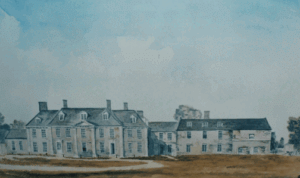
In April 1752 aged just nine years old Joseph was sent to the boarding preparatory school at Harrow. From this point onwards Revesby Abbey was a place for school holidays not as a resident. He made little progress at Harrow, perhaps the academic focus on Latin and Greek were a challenge to his independent spirit and he missed the broad acres of Lincolnshire.
He entered Eton on 11th September 1756 and was perhaps fortunate that by this time Dr Barnard was headmaster, Barnard was not one for flogging boys who could not master Latin, (unlike his predecessor) he was a disciplinarian but was also an uncommonly amiable man. It was here after swimming in the Thames one evening that the slim evidence of Everard Home suggests was the turning point in Joseph Banks life with the realisation that the beauty around him was worthy of his full attention, and thus began his lifelong devotion to natural science and in particular botany.
He carried this ambition forward to Oxford where he took residence on 20th December 1760. Unfortunately, under the Sherardian professor Dr Humphrey Sibthorpe, (a Lincolnshire man) botany was not flourishing, reputedly he had not delivered a lecture for 25 years. Fortunately, at his own expense, he was able to bring from Trinity College Cambridge the young Israel Lyons (1739 -1775) to deliver a Summer course in Botany. Soon after this he left Oxford with his ‘honorary degree’ to enter the new world of science in London and the new British Museum where he was to meet a small circle of friends not least of whom was Daniel Solander who became a lifelong friend. Banks now sought a new challenge and that came with the opportunity to sail as a supercargo in the fisheries protection vessel HMS Niger, under Captain, Sir Thomas Adams. He was fortunate to have the company of his old friend now in the navy. Lieutenant Constantine Phipps, FRS (1744 – 1792) a colleague of great influence in future years. His adventures were about to begin.